Format: One-day session, school STEAM day, or unit opener | Grades: K–5 | Also offered as: Teacher professional development
What we do
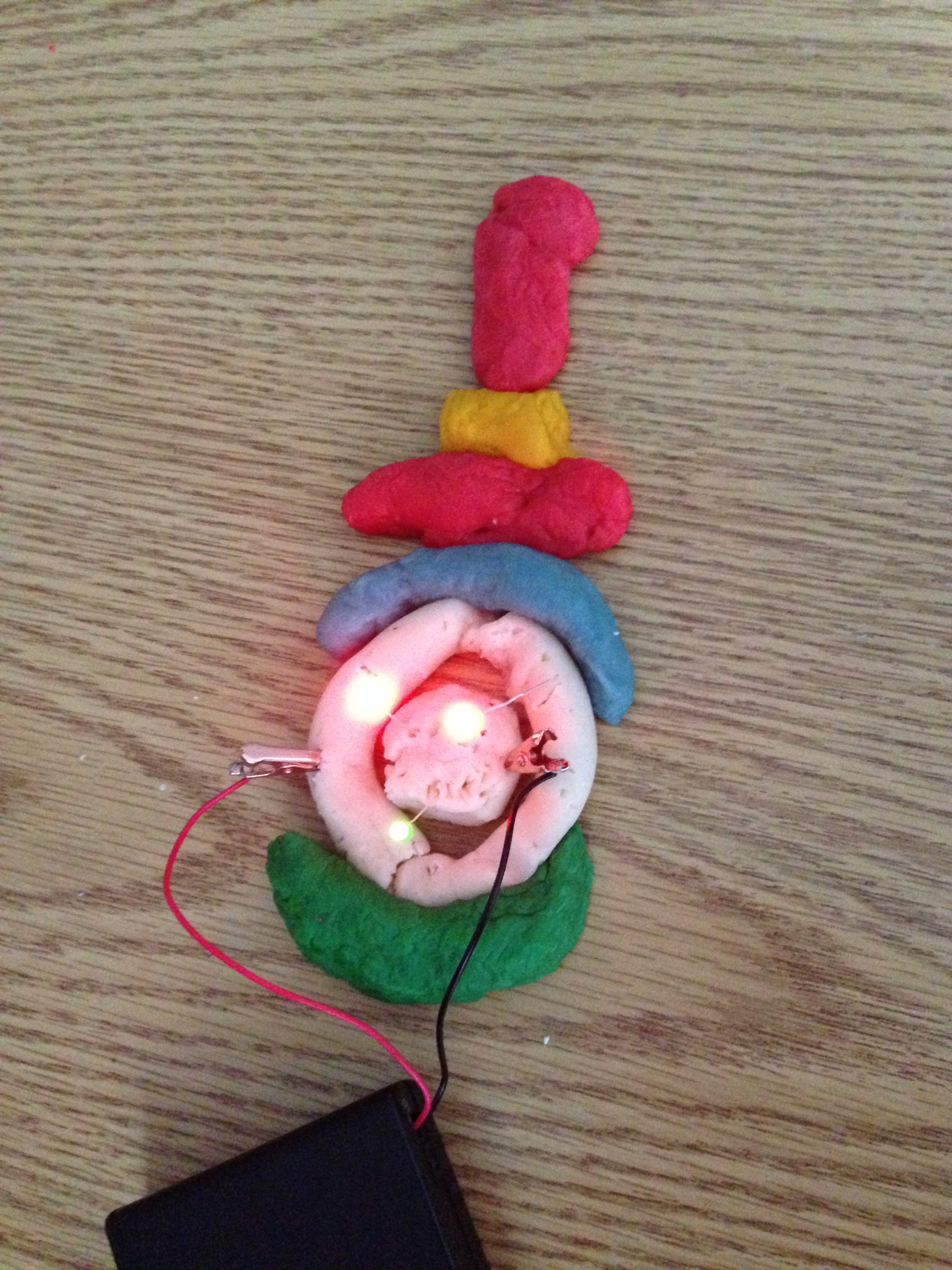
Beginning Circuitry is our most-requested activity. Students learn how electricity flows from a power source through a complete loop, what a “short” is, and then build their own circuits using battery packs, conductive dough, and LED lights. Once they master a basic circuit, students build both series and parallel circuits, then design their own light-up sculptures.
Students consistently surprise us. Some have built their battery into the sculpture itself to make a more finished piece of art. One student mixed red and blue dough to create a purple glowing butterfly.
The photos below follow a typical session: our circuit discussion, staff examples, students building basic circuits, and finally students creating circuits as part of their own works of art.
 |
 |
 |
 |
|
 |
 |
 |
 |
|
 |
 |
 |
 |
|
 |
 |
 |
 |
|
 |
 |
 |
 |
Where we’ve run it
- Fry Elementary School STEAM Day (Indian Prairie School District): 2016, 2017, 2018, 2019, 2024, 2025, and 2026
- Emerson Elementary PTA STEM Fair (2015)
- NEW 200 Foundation STEM Expo (2016)
- Metea Valley High School teacher professional development (2016)
- Student Excellence Foundation STEM Expo (2017)
- Emerson STEAM Night (2019)
Standards addressed
- NGSS 4-PS3-2: Make observations to show that energy can be transferred by electric currents.
- NGSS 4-PS3-4: Apply scientific ideas to design, test, and refine a device that converts energy from one form to another.
- NGSS 4-ESS3-1: Describe how energy and fuels are derived from natural resources.
- Visual Arts VA:Cr2.1: Explore and invent art-making techniques and approaches.
To bring Beginning Circuitry to your school, contact steve@rubberbandproject.org.